

The Rise of Digital Neigborhoods and Why Every Brand Needs One

Community has always been a connective tissue between brands and customers. From local town squares to online forums, the spaces where people gather define the way trust, influence, and commerce unfold. But the static online community models of the 2010s: Facebook Groups, LinkedIn Groups, even early Slack collectives are giving way to a more dynamic structure: the digital neighborhood.
Digital neighborhoods are not just channels or groups. They are layered ecosystems where creators, community leads, and customers play interdependent roles, producing both belonging and business outcomes. Brands that learn to design these neighborhoods as infrastructure rather than side projects are winning. Reddit threads have the potential to influence financial markets, Discord servers were able to incubate billion-dollar NFT economies, and Circle hosts micro-neighborhoods that power entire SaaS ecosystems.
This post defines digital neighborhoods, outlines the architecture behind them, and shows why every brand serious about retention, loyalty, and network-driven growth needs to treat them as a core strategic asset.
Defining the Digital Neighborhood
A digital neighborhood is best understood as a layered, living network rather than a static audience or forum. It has three defining characteristics:
-
Multi-role structure
Unlike traditional communities where everyone is a “member,” digital neighborhoods support distinct but overlapping roles: creators generate content and spark dialogue; community leads organize and govern; customers engage, consume, and contribute. -
Fluid participation
Members do not sit in silos. A customer might evolve into a creator, or a community lead may step back and let micro-groups self-govern. Movement is expected, not resisted. -
Network effect design
The value of the neighborhood compounds as more people interact through the density and quality of relationships as opposed to increasing purely based on number of users.
Each layer feeds into the next: creators spark energy, leads shape flow, customers fuel adoption.
Why Static Community Models Are Breaking Down
The static community model like forums where brands drop content and hope for engagement has three flaws:
-
Lack of dynamism: Static communities assume members want to stay in one place. In reality, digital behavior is nomadic. People move across Discord, Reddit, Substack comments, and back again.
-
Shallow roles: Treating everyone as a “member” fails to recognize power users, contributors, and moderators who create outsized value.
-
Low signal density: Large groups often become noisy without clear role structures, leading to disengagement.
Benchmarking the New Neighborhoods
Looking at today’s most influential platforms highlights the patterns:
-
Governance: Subreddit mods wield authority, often independent of brands.
-
Engagement: High density of knowledge exchange, fueled by upvotes/downvotes.
-
Economics: While indirect, Reddit shapes product adoption and even stock markets.
Discord
-
Governance: Admins run servers with customizable roles and permissions.
-
Engagement: Real-time, synchronous conversation builds intimacy.
-
Economics: From NFT communities to SaaS beta groups, Discord is the de facto R&D lab for digital products.
Circle
-
Governance: Brand-driven, but modular. Cohorts, courses, and hubs allow for structured pathways.
-
Engagement: Threaded discussions plus integrations (events, courses, payments) drive stickiness.
-
Economics: Circle-based communities have enabled solopreneurs to generate six-figure MRR while SaaS companies use it to anchor retention.
The Business Case for Digital Neighborhoods
For executives evaluating the ROI of a neighborhood strategy, three dimensions stand out:
Retention Economics
Members who participate in community-based learning and support show 30–40% higher renewal rates. Customers embedded in a neighborhood are less likely to churn because their sunk cost is social, not just financial.
Expansion Pathways
Neighborhoods accelerate upsell and cross-sell. Peer influence drives adoption of advanced features. Insights from a Product Leaders Network showed that “92% of consumers trust recommendations from individuals over branded content, meaning that your community members can become your most effective marketing channel.”
R&D Feedback Velocity
When beta users gather in a shared space like Discord, Circle, Slack, etc, they may act as a live usability lab. Product teams can observe, test, and refine features continuously, often cutting meaningful time from validation and reducing the cost of misfires.
Governance Models in Practice
Digital neighborhoods thrive when they’re architected through governance. Across modern community platforms like Mighty Networks, Circle, and Skool, we see three dominant models:
Creator-Governed Communities
Think Skool classrooms run by course creators, coaches, and thought leaders.
-
Power source: Audience trust and personal expertise.
-
Governance style: Centralized; one voice sets the tone, norms, and rhythm.
-
Economics: Monetized via memberships, cohorts, and premium access.
-
Risk: Overdependence on the creator’s bandwidth and brand.
Brand-Governed Communities
SaaS or B2B brands building structured spaces on platforms like Circle or Mighty Networks.
-
Power source: Organizational intent for retention, advocacy, product feedback.
-
Governance style: Programmatic via community managers orchestrating events, cohorts, and peer support.
-
Economics: Measured through retention, expansion, and NRR impact.
-
Risk: Over-engineering; if the space feels corporate
Hybrid or Distributed-Governed Communities
Communities where influence is shared among members like the decentralized dynamics on Reddit or open Discord groups.
-
Power source: Collective ownership and cultural momentum.
-
Governance style: Moderated but emergent; norms are enforced by peers, not staff.
-
Economics: Indirect via brands and creators that benefit from reputation, reach, and insight.
-
Risk: Quality control and alignment with business objectives.
Bottom line
The difference between a vibrant “digital neighborhood” and a silent one usually isn’t content or incentives. It’s who holds the keys, how decisions are made, and whether members feel both guided and empowered.
Each model has trade-offs. Creator-led neighborhoods scale personality-driven influence but risk burnout. Brand-led models align directly to business metrics but can feel sterile if not designed for member agency. Hybrid-led models are resilient but harder for brands to steer.
Designing Digital Neighborhoods
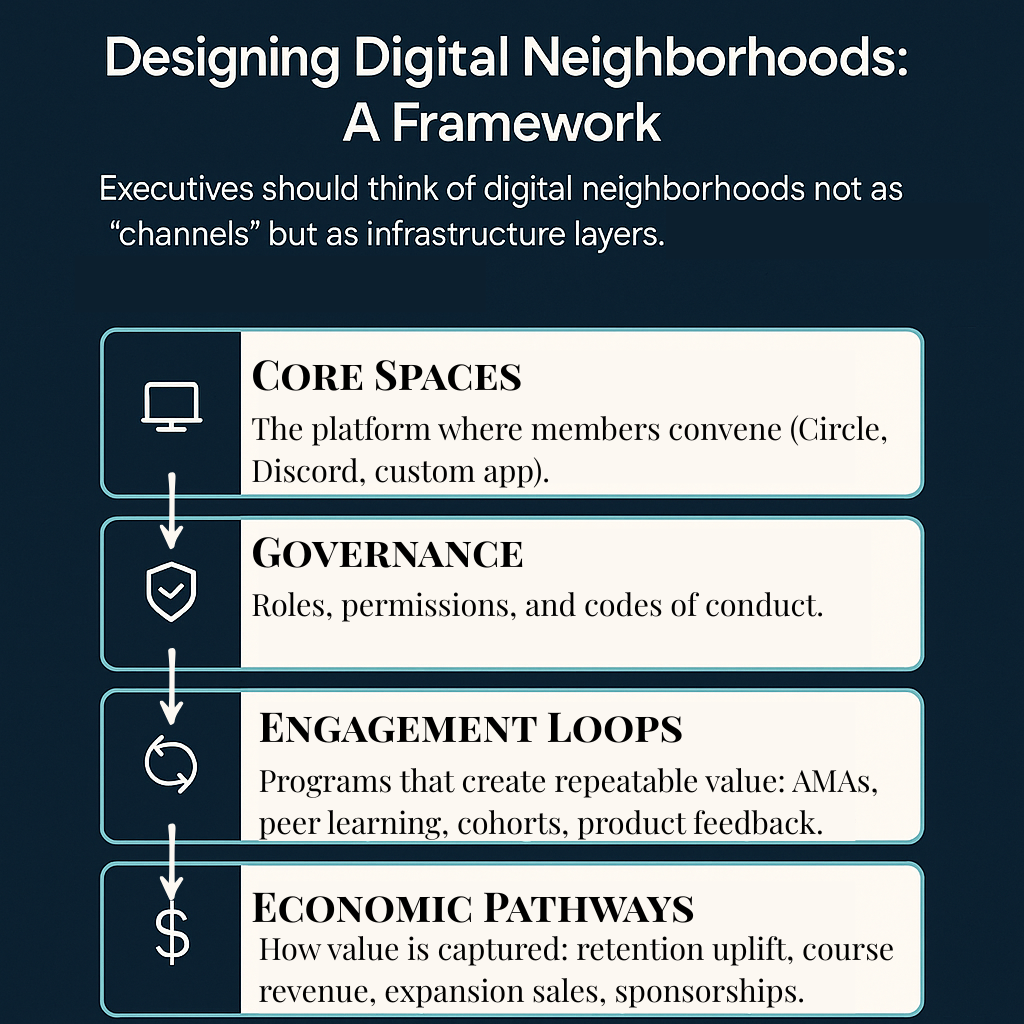
For leaders building neighborhoods, there are five signal taxonomies worth monitoring:
-
Participation Depth: How many members evolve into contributors or creators.
-
Feedback Velocity: Time from user problem surfaced to team response.
-
Cross-role Migration: Instances of customers becoming co-leads or creators.
-
Retention Correlation: Renewal rates between active vs. inactive members.
-
Expansion Yield: Add-on adoption from community participants.
Why Organizations Need Their Own Digital Neighborhoods
The competitive edge in SaaS and beyond is no longer just product or price. It is also about relationship density. Customers expect to learn, share, and co-create with others in your orbit. Without a neighborhood, you are relying on transactional loyalty in a world where network-driven loyalty compounds.
Brands that ignore this shift risk three outcomes:
-
Higher churn, as customers migrate to competitors with built-in communities.
-
Slower product cycles, as feedback loops remain shallow.
-
Higher CAC, since word-of-mouth lacks a neighborhood engine.
Conversely, brands that invest in digital neighborhoods unlock:
-
Durable retention advantages.
-
Expansion revenue driven by peer validation.
-
R&D velocity that compounds product-market fit.
What’s Next for Your Strategic Imperatives
Digital neighborhoods are not “nice-to-have.” They are the new infrastructure of customer growth, loyalty, and innovation. Whether you are a Series B SaaS team or a mature enterprise, the design of your digital neighborhood will increasingly determine your unit economics.
The question is no longer if you need one, but how you will structure it. The smartest leaders are already auditing their ecosystems, mapping role layers, and building engagement loops. If you want to understand how to architect your own digital neighborhood, this is the moment to take action.
Join our community or reach out directly if you want to design a digital neighborhood that compounds value for your customers and your business.