
From Transactions to Tribes: Building Brand Loyalty in 2026

Customer loyalty is undergoing a seismic shift. Transactional tactics like discount codes, loyalty points, one-off rewards are not only losing effectiveness, but they are starting to erode trust. Customers have grown desensitized to gimmicks and are seeking something deeper like identity, belonging, and shared purpose. Brands that continue to treat loyalty as a ledger of discounts will bleed long-term value in ways they cannot see on their dashboards until it is too late.
The winners will be those companies who evolve from transaction-oriented to tribe-organizing! These innovators will architect loyalty outside of the customary “perks” that have become table stakes. They will build community-centered systems where customers become members, advocates, and co-creators to their success.
In this article, we will explore:
-
Why transactional loyalty is failing
-
The hidden losses most brands ignore
-
How community-centered loyalty creates durable retention and advocacy
-
An approach for moving from transactions to tribes
-
Action steps for leaders ready to evolve
The Decline of Transactional Loyalty
Why the “Perks” No Longer Work
For decades, brands relied on transactional programs: points, coupons, flash sales. These were designed to drive short-term conversion but not necessarily long-term connection. Unfortunately, a few forces have converged to erode the effectiveness of transaction based perks including:
-
The Commoditization of Rewards: Every brand offers points, perks, or discounts. Differentiation is impossible when your competitor can match the same benefit instantly and for less money.
-
Loyalty Fatigue: Research shows that over “50% of loyalty members say hotel loyalty programs no longer offer the value they once did.” The psychological novelty has worn off.
-
Algorithmic Arbitrage: In a digital-first world, customers can find the “best deal” instantly. Transactional loyalty collapses in the face of price-comparison tools and automated shopping assistants.
The result: brands are trapped in a race to the bottom, burning margin while failing to generate real loyalty.
✨ Ask Lonnie about Transactional vs Tribal Loyalty ✨
What Brands Don’t Realize They’re Losing
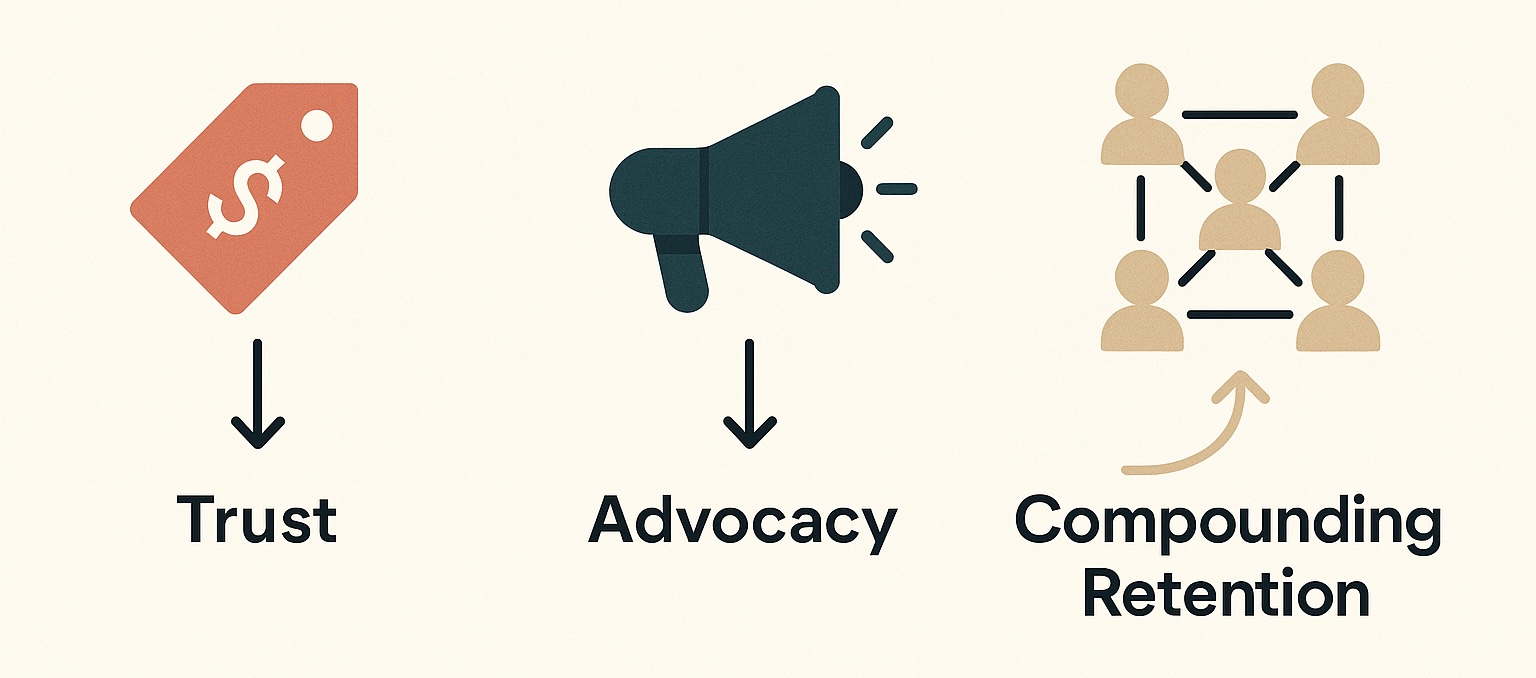
Transactional loyalty doesn’t just fail to build, but it actively erodes customer loyalty. When organizations treat customers as buyers instead of members, they quietly lose three compounding assets:
-
Trust: If loyalty is only ever purchased with discounts, customers internalize that the brand’s value lies in price, not their product. Trust erodes when they feel manipulated by constant offers.
-
Advocacy: True advocacy where customers voluntarily bring in new members cannot be bought with coupons. Transactional programs rarely convert buyers into raving fans.
-
Compounding Retention: Community-centered models create network effects. Each member adds value to others. Without this, retention plateaus and LTV remains flat.
The hidden cost is staggering. Bain & Company theorizes that “by increasing retention by as little as 5 per cent, profits can be boosted by as much as 95 per cent.” By failing to invest in compounding loyalty, brands are bleeding out value silently.
The Power of Community-Centered Loyalty
Community-centered loyalty reframes the relationship. Instead of extracting transactions, brands create spaces where customers feel identity, belonging, and shared value.
The difference:
-
Transactional loyalty: “Buy again and we’ll give you 10% off.”
-
Community-centered loyalty: “Join us, belong here, and build with us.”
This model has three structural advantages:
-
Identity Alignment: Members see themselves reflected in the brand. They aren’t just using the product. They are part of something larger.
-
Belonging & Connection: Community provides relational glue. Customers stick around for more than the points and perks. They stay because they belong to a network they value.
-
Shared Value Creation: The community co-creates with the brand and encourages sharing knowledge, producing content, and hosting events. Loyalty compounds through contribution.
How to Shift from Transactions to Tribes
Evolving to tribe-driven loyalty requires deliberate architecture. Below is a phased approach your team can adopt to see where you are today and what’s next:
Phase 1: Transactions
-
Tactics You’ll See: Discounts, points, coupons
-
Signals You’re Here: High churn despite repeat purchases, weak advocacy, low engagement beyond checkout
Phase 2: Engagement
-
Tactics You’ll See: Content, events, education, gamification
-
Signals You’re Here: Members begin engaging beyond purchase, consuming resources, attending events
Phase 3: Belonging
-
Tactics You’ll See: Peer-to-peer groups, forums, brand identity behaviors
-
Signals You’re Here: Customers self-identify as part of the brand, member-led initiatives emerge
Phase 4: Tribes
-
Tactics You’ll See: Co-creation, governance, brand ambassadorship, community-led growth
-
Signals You’re Here: Loyalty is no longer incentive-driven; members recruit others, generate IP, and defend the brand publicly
This progression mirrors Maslow’s hierarchy applied to loyalty: from survival (discounts) to self-actualization (tribal identity).
Why This Will Matter in 2026
The SaaS market is saturated, switching costs are lower, and customers are more informed than ever. Considering this landscape, competing on product or price is no longer sufficient. Therefore, loyalty must be built on emotional infrastructure and not financial gimmicks.
Those who evolve to tribe-driven models will:
-
Unlock compounding LTV
-
Reduce dependency on paid acquisition
-
Create moats competitors cannot replicate with a coupon code
Those who fail will continue to burn cash in the name of “loyalty,” without realizing they are eroding the very asset that drives durable growth.
Next Steps for Leaders
To remain relevant, it’s imperative that leaders stop buying loyalty and start building it. To begin, audit your loyalty architecture against the four phased approach above. Identify whether your brand is stuck in the transactional stage and what shifts are needed to move toward belonging and tribes.
This transition is not only cosmetic — it’s critical infrastructure that successful organizations cannot ignore if they hope to remain competitive. While this shift requires new KPIs, new operating systems, and new forms of leadership buy-in, the return is exponential.
To accelerate this journey, you can join Christian Alonza to invest in and build more Community Capital for your organization
The brands that act now will not just have customers in 2026. They will have tribes. And tribes, unlike transactions, endure.