

How Branded Communities Unlock Growth Beyond CAC

The SaaS model is under pressure. CACs are rising, growth capital is less abundant, and retention is the real frontier of enterprise value. In this landscape, branded communities have shifted from “nice to have” to strategic infrastructure.
This article covers how communities reduce CAC, increase LTV, and compound enterprise value.
Where Community Fits
Community-driven companies shift spend from pure acquisition to infrastructure that compounds:
-
Lower CAC: word-of-mouth and peer validation drive lower-cost pipeline.
-
Higher LTV: engaged communities reduce churn and increase expansion.
-
Strategic moat: communities are harder to replicate than ad budgets.
Community as an Acquisition Channel
The Trust Deficit
Buyers trust their peers more than brands. As Forrester analyst Ian Bruce put it “B2B buyers rarely act alone” and he found that 82% of B2B buyers say peers are the most trustworthy source of information while vendors salespeople rank among the “lowest trusted sources.”
Community-Qualified Leads (CQLs)
Communities produce a new pipeline category: CQLs. These are prospects whose buying intent is surfaced through interaction in the community, often before MQL criteria are met.
Signals that define CQLs:
-
Posting questions about implementation or pricing.
-
Participating in niche subgroups (e.g., “Enterprise Security Leaders”).
-
Attending vendor-hosted community roundtables.
Community as a Retention Engine
Why Customers Churn
Common churn drivers include:
-
Lack of ongoing value realization.
-
Poor onboarding and product adoption.
-
Feeling disconnected from peer use cases.
The Retention Flywheel
Communities provide:
-
Peer support: reducing support tickets by over 20%.
-
Knowledge exchange: improving adoption of advanced features.
-
Emotional switching costs: users embedded in a peer network are less likely to churn.
Expansion Revenue and Advocacy
Communities as Expansion Catalysts
Expansion doesn’t come from upsell emails. They come from customers seeing peers solve bigger problems with your product.
Expansion triggers inside communities:
-
Feature showcase sessions.
-
Peer case studies posted by other customers.
-
Informal benchmarking conversations among operators.
Advocacy as a Growth Lever
Branded communities create an engine for referrals, testimonials, and co-marketing. In many SaaS companies, increased pipeline can be attributed to customer advocacy born inside community programs.
Designing Community as Infrastructure
Avoiding the “Feel-Good Trap”
Most communities fail because they’re designed as content hubs instead of value generating infrastructure. Here’s a litmus test to use: can you show a direct line between community activity and revenue outcomes? If not, consider taking our Community Capital Course for a self-guided methodology built to help you operationalize community as a strategic growth engine.
The Infrastructure Blueprint
-
Audit Signals: Map existing peer-to-peer interactions across support, social, and user groups.
-
Platform with Intent: Choose a hub (Slack, Circle, Discord) that aligns with your ICP.
-
Operationalize Engagement: Treat engagement like a product with defined KPIs.
-
Revenue Alignment: Tie community KPIs to revenue KPIs (e.g., NRR, CAC, expansion revenue).
Metrics that Matter
-
% of pipeline sourced from CQLs.
-
Reduction in support ticket volume.
-
NRR lift among active community members.
-
Expansion revenue influenced by community touchpoints.
The Compounding Effect
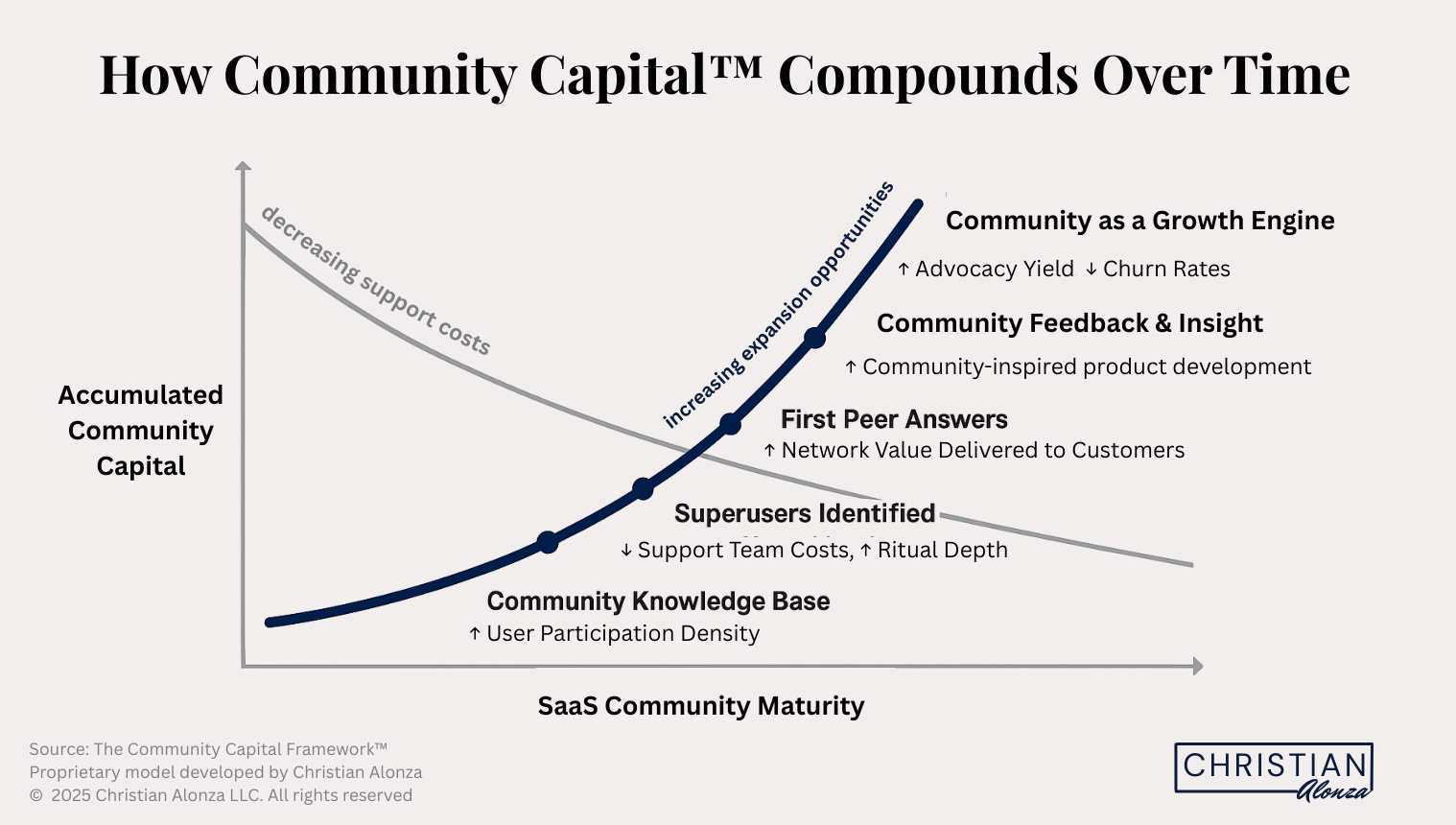
Think of community like product development. The upfront cost is high, but returns compound over time. Each new member doesn’t just add value; they multiply it by increasing trust density and peer learning.
-
Year 1: CAC reduction begins.
-
Year 2: Retention lift materializes.
-
Year 3+: Expansion revenue and valuation premium emerge.
This is why branded communities are not campaigns but infrastructure. They don’t deliver overnight results, but over a three-year horizon, they shift the economics of growth.
What’s Next
SaaS economics are evolving. Growth at any cost is out. Efficient growth is in. Branded communities are one of the few levers that reduce CAC while simultaneously increasing LTV, making them true revenue multipliers.
Founders and CXOs who approach community as infrastructure will outcompete those who treat it as content marketing.
If you’re serious about shifting from transactional growth to compounding growth, get access to Community Capable for ideas on building a community that doesn’t just look good, but drives revenue.